Four Ways to Build Community Through Events: An interview with Tim Sarrantonio and a guide to boost your GivingTuesday plans.
Ahead of GivingTuesday on December 1, we sat down with Tim Sarrantonio, founder of The Generosity Spectrum and the Capital Region GivingTuesday community leader. Tim chairs the Fundraising Effectiveness Project and created The Generosity Roundtable, a facilitated card game and peer learning network where nonprofit people, volunteers, and neighbors practice working through real problems together.
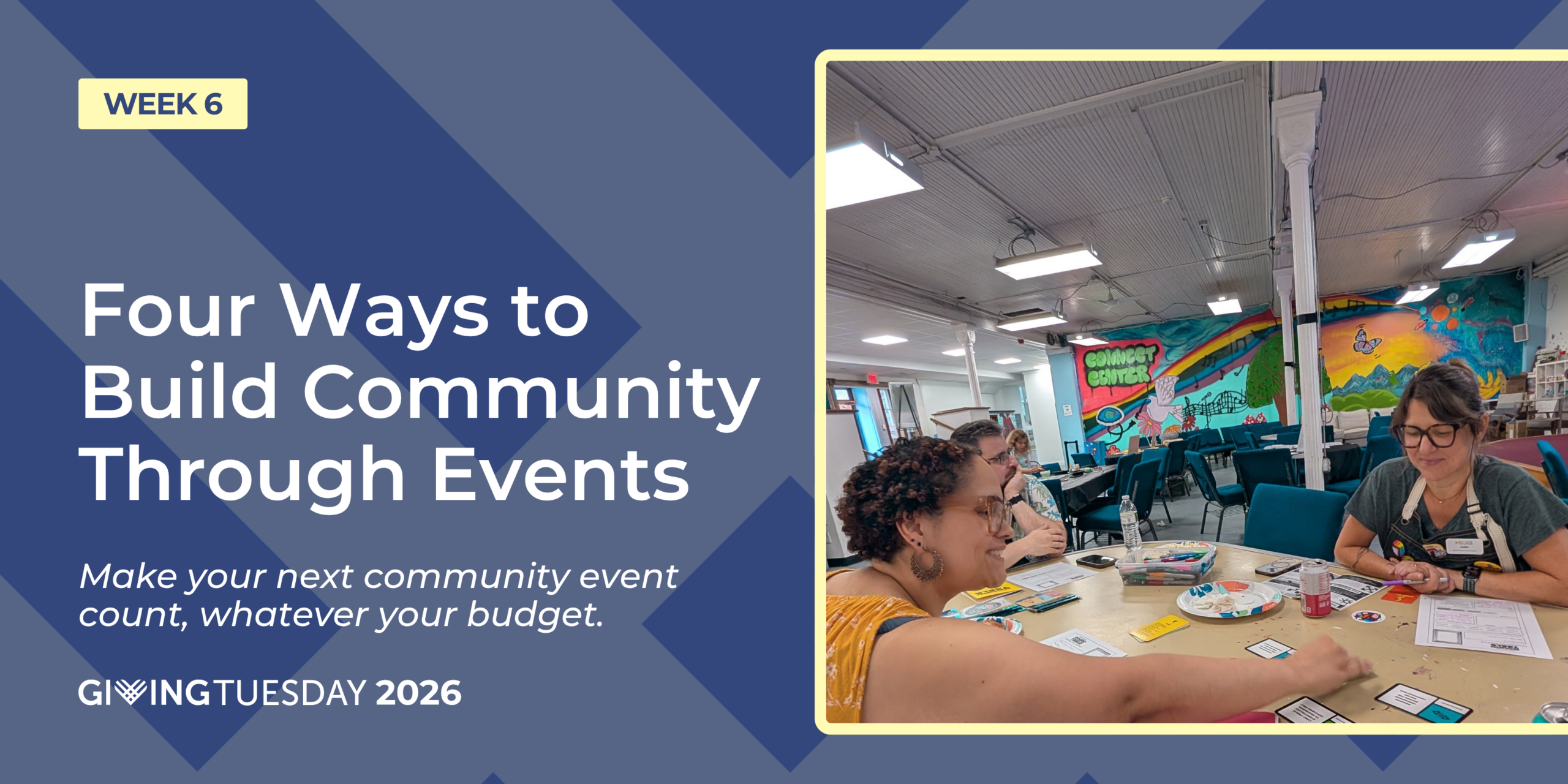
On TogetherTuesday, Tim and The Connect Center in Cohoes, New York, turned a single June day into two rounds of play. The morning table seated nonprofit leaders next to a 16-year-old volunteer, and a looser, more organic round filled the room that evening.
None of it required a venue rental or a catering contract.
In this special GivingTuesday blog feature, Tim shares four ways to build an event around community regardless of budget. He covers where to find a room, how to feed people and share the costs, when to take it outside, and when a screen is the right table, with lessons from that TogetherTuesday morning running through each one.
Start With the Room Someone Already Has
People have always found a way to gather regardless of resources, as long as someone offered a place and a reason. When coffeehouses spread through seventeenth-century London, the penny that bought a cup of coffee also bought hours of newspapers and debate, which is why people started calling them penny universities. Two centuries later, cigar rollers in Tampa’s Ybor City each chipped in up to 25 cents a week to pay a lector who read newspapers and novels aloud on the factory floor, and the workers themselves chose what got read. Pooled pocket change turned a factory into a classroom. Neither tradition needed a grant.
Each needed a room that already existed and people willing to share it.
That is still the best approach. By default, the Generosity Roundtable tries to build on spaces and relationships that already exist. Our home base in the Capital Region is The Connect Center, an old church that Ben Williams and his team turned into a youth center with a STEAM lab, a professional kitchen, and a food pantry. It has become an amazing place to dream together and try out new formats, and we’ll be leaning on it for trainings leading up to GivingTuesday as well as a volunteer fair on the day itself. When you’re working with limited resources, making full use of the space you already have is critical.
The conversation at our TogetherTuesday table was built around that same reality. We used a fictional nonprofit from our organization generator, a very small, volunteer-driven group of the kind that makes up so much of the sector, as a way to work through what building a community looks like when money and staff are scarce.
Here’s how to make it work:
- List the rooms that already belong to your community, such as library meeting rooms, faith community halls, youth and community centers, and historical societies, and find out who manages each one.
- Pitch the partnership as a trade. You bring new people and fresh programming through their doors, and they bring the space, the chairs, and often a spot on their community calendar.
- Write the basics into a one-page agreement covering setup, cleanup, and who holds the keys, so the second event is easier than the first.
- Invite everyone to help reset the chairs at the end. It turns guests into collaborators.
A rule we carry into every Generosity Roundtable is the Empty Chair Rule, which we learned at Knutpunkt, the Nordic live-action role-play gathering, and which asks you to always leave one seat open as an invitation to whoever isn’t in the room yet.
Feed People Local, and Fund It Together
Food is usually the biggest line in a small event budget, and it is also where the most goodwill is waiting. In my experience, a local, family-owned business will say yes faster than a chain, because the owner is standing behind the counter and knows the people who will be in the room. We consistently turn to Meat & Company, a barbecue spot in Niskayuna, and the reason is Ben. He has worked with them on a whole range of projects, and that shared history is what made us feel we could trust them. It lines up with what we’re learning through the Aspen Institute’s Alliance for Social Trust, which is that this kind of trust can’t be rushed. Relationships like these are built intentionally, over time, one project at a time.
However, food is only one piece. The same principle applies to the corporate brands you already have a relationship with. I’m an ambassador for Athletic Brewing, and that existing connection means we’re able to get products donated for our gatherings. Before you cold-pitch a sponsor, look at the companies where you, your board, or your volunteers already have a foot in the door.
Here’s how to make it work:
- Ask local first. Walk into the restaurant you already love and ask for a donated tray, a discount, or a partnership where you promote them to every guest.
- Offer real visibility in return by thanking them by name from the front of the room, tagging them in every post, and sending people their way afterward.
- Start with the relationships your partners already have. A business your host site has worked with for years will say yes more easily than a stranger.
- Map the brands you and your volunteers are already connected to as customers, ambassadors, or employees, and ask for donated product before asking for cash.
- Fill the gaps with a potluck and a simple coffee and tea table. Hospitality that guests help build becomes part of the event.
Give your partners enough time to say yes, and ideally make the ask six weeks before the event.
Let the Purpose Pick the Place
Outdoor events can be wonderful and nearly free. A park, a trail, a community garden, or a block closed for an afternoon draws people who would never walk into a meeting room, and service projects like cleanups and trail days give everyone something to do with their hands, which makes conversation easier. Outdoor events carry hidden costs in weather backups, permits, restrooms, shade, and the sound problem that shows up the moment more than a dozen people are talking at once.
Indoor events buy you control. For anything that asks people to think together, I want tables, walls, and a room calm enough to hear the person across from me. That mattered on TogetherTuesday, because the most important moment of the morning was easy to miss. The scenario card was built for two seats, a board member and a staff fundraiser arguing over whether a stalled GivingTuesday campaign needed growth or authenticity. We added a third chair because a teenaged volunteer from The Connect Center wanted to play. They chose the Evaluator, whose card asks for evidence first, but also in play, they kept listening for something else: the people whose voices were being left out of the process. A small table in a calm room is what let everyone hear that.
Here’s how to make it work:
- Choose outside when the activity is doing something together in ways that need a lot of movement or energy, such as a cleanup, a planting, a walk, or a festival.
- Choose inside when the activity is thinking something through together, such as a workshop, a story circle, or a round of play.
- If you go outside, book the rain location first and treat it as the real plan.
- Either way, arrange seats in a circle or around shared tables, and keep one open. It costs nothing and changes how attendees approach meeting new people.
Let the purpose pick the place, and wherever you land, arrange the seats so everyone can see each other.
Virtual or In Person? Use Each for What It Does Best
I’ve built both. During the pandemic I helped create Generosity Xchange, a virtual peer conference that showed us people will show up online to learn from each other when they can’t be together any other way. This fall the Generosity Roundtable is running free virtual sessions through our Community Hive with the Nonprofit Hive, and a September virtual table pulled roughly forty nonprofit professionals into a single live game. Virtual is the right call when reach matters more than depth, when your people are spread out, and when caregiving, disability, or travel costs would otherwise keep someone home.
Yet in-person gatherings do something a screen struggles to match. GivingTuesday’s own research finds that people who value helping others and see their community sharing those values reported recent generosity at about 74 percent, compared with roughly 66 percent for helpers who felt isolated. What that means is that generosity spreads when people can see it happening around them. The same GivingPulse research shows that people who get more opportunities and prompts to give tend to score higher on civic intent, and an in-person event is one of the most direct invitations you can make.
Our TogetherTuesday table said much the same thing in its own way. Across three rounds, the players had two chances to automate, once with automated communication workflows and once with website chatbots. They passed on both, and the only automation-curious voice in the room was the board member. The table leaned toward speed in operations and toward a single consistent voice in communications, then opened wide on engagement, choosing to invite supporters in through a variety of ways. When it came to how people meet the organization, the table chose people.
Here’s how to make it work:
- Go virtual when your community is spread out, when schedules are brutal, or when you want a low-stakes first step.
- Go in person when trust is the goal, when you want neighbors to meet neighbors, or when you’re asking people to take on a role.
- Try a hybrid anchor. This November we’re hosting local gatherings in communities tied to the virtual Nonprofit Social Media Summit, so people can watch together and keep talking at the same table afterward.
A screen can widen the circle, and a shared room tends to deepen it, so choose the one your goal actually needs.
The Big Lesson Was a RACI Chart
Looking back on the session afterward, what stayed with us was how often the conversation circled around ownership. The board member, the staff fundraiser, and the volunteer each had a clear sense of what mattered, and the harder question was who would carry that work once the cards were put away. Melissa, the fundraiser at the table, had even named their own blind spot out loud, a pull toward new relationships at the expense of stewardship.
Reflecting on all of that, the resource we kept coming back to was a simple RACI chart, which spells out who is Responsible, Accountable, Consulted, and Informed for each piece of work. It is maybe the least glamorous and most useful thing you can put in people’s hands after a gathering.
The same holds for low-budget events. When you’re running on borrowed rooms, donated food, and volunteer time, nobody is being paid to catch what falls through the cracks. Clarity about roles does the work a budget usually does. Here’s a slice of what that looks like for a community gathering:
Download the free Community Event RACI Chart, a one-page printable covering everything from confirming the room to the debrief. Fill it in with your partners before the event, and adapt the roles to the people you’re actually working with.
None of the traditions that built public life started with a budget. The penny universities, the lectores, and the Highlander Folk School, which Myles Horton and Don West opened in 1932 on the conviction that ordinary people could build on what their own experience had taught them, each began with a room, an invitation, and people willing to share what they had. GivingTuesday on December 1 is a good day to join that lineage. In the Capital Region, you’ll find us at The Connect Center for the Capital District Volunteer Fair, with Generosity Roundtable tables open to anyone who wants to play.
So here’s the question I’d leave you with. Which room in your community sits empty on a Tuesday night, and who do you already know who holds the key?
More Resources
- Generosity Toolbox (GivingTuesday)
- TogetherTuesday and the Community Action Playbook (GivingTuesday)
- Civic Intent Research from GivingPulse (GivingTuesday Data Commons)
- Community Event RACI Chart, free download (The Generosity Roundtable)
- The Generosity Roundtable Community Hive (The Generosity Spectrum)