So we hear you have a great GivingTuesday campaign cooked up, but now you need people to know about it AND take action? We’ve got you covered.
We’re Emily Parker and David Imani – we run a strategy and creative studio called PLAYING. Our clients range from social impact to consumer packaged goods (CPG) brands to public institutions to arts and entertainment because our specialty is not just one industry, it’s people and what moves them. Working with GivingTuesday is a joy, and we get to do so with our collaborators Bruna Da Costa, Greg Falconi (who also runs a fantastic creative studio called Curamica) and his design partner Alexandra Vitale. This blog post is a big, long compilation of the questions we ask ourselves every day in our work, along with some pro tips to help supercharge your work.
By the time you’re done reading this, we hope you have the fundamental know-how to reach the right people with the right message in the right place at the right time so that they join your GivingTuesday campaign and continue engaging with you.

Building Your Foundation
The most important step is laying a strong foundation by setting your strategy. This allows you to make an impact at any level of budget and resources because a focused and well-crafted strategy sharpens your work and increases the effectiveness of everything you do.
Here’s our 5-step process to developing your strategy:
1. Understand your business need(s): Clarify the core business or organizational need that you must meet.
2. Develop goal(s) and KPIs: Set your campaign goals and determine the key performance indicators that will help you measure success.
3. Know your audience: “Everyone” is not an audience, so who is? Get as detailed as you can about who exactly you want to engage in your efforts.
4. Determine the best channels to activate: Where is your audience paying attention? Do you have the resources needed to show up there?
5. Create your message and your materials: What do you want to say and how do you want to say it? Keep it focused, actionable, and valuable to your audience.
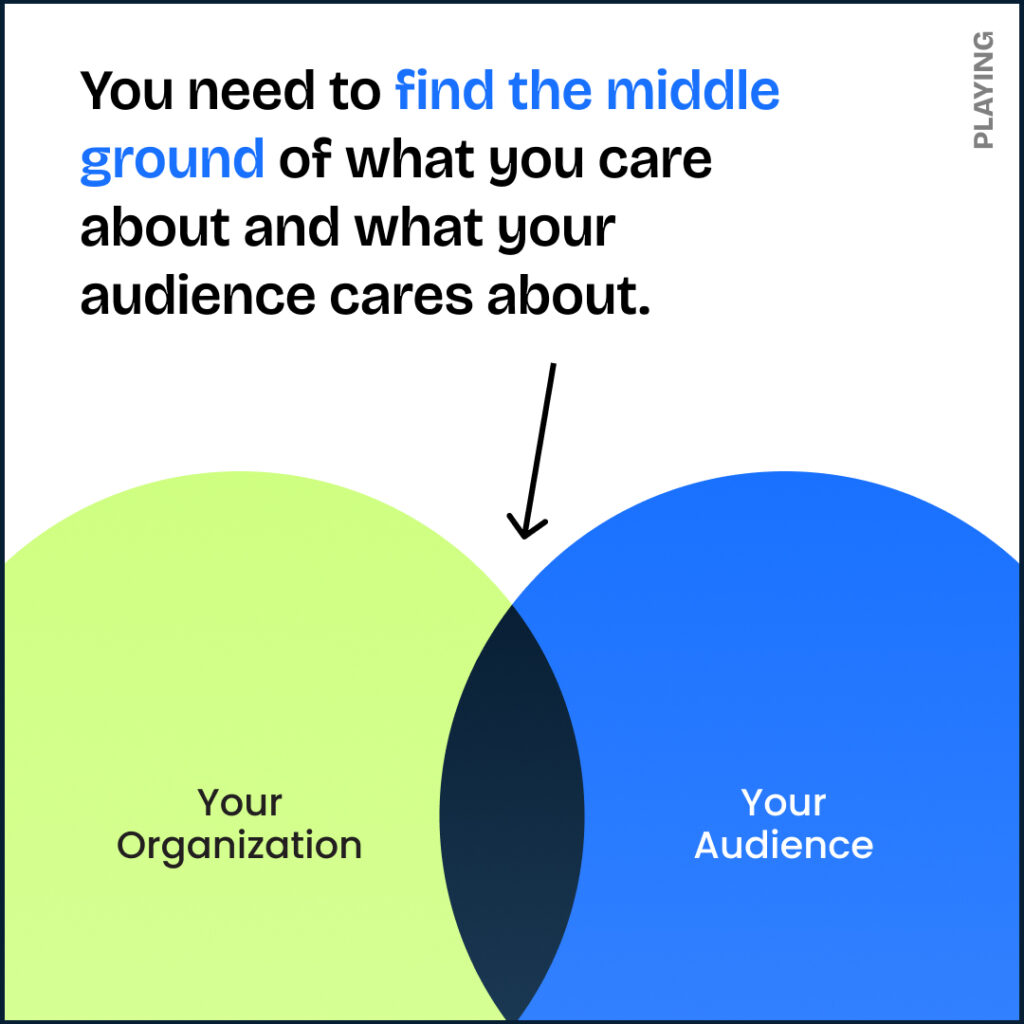
All of this is to help you find the middle ground of what you care about and what your audience cares about.
Once we understand what we care about and what our audience cares about, our job as marketers is really to help people move through a journey.
You might have heard this called a marketing funnel: awareness, consideration, conversion, and then ideally, loyalty. Someone first needs to know you exist, then understand why they should care, then decide to do something, and, ultimately, we want to build enough of a relationship that they stay engaged.
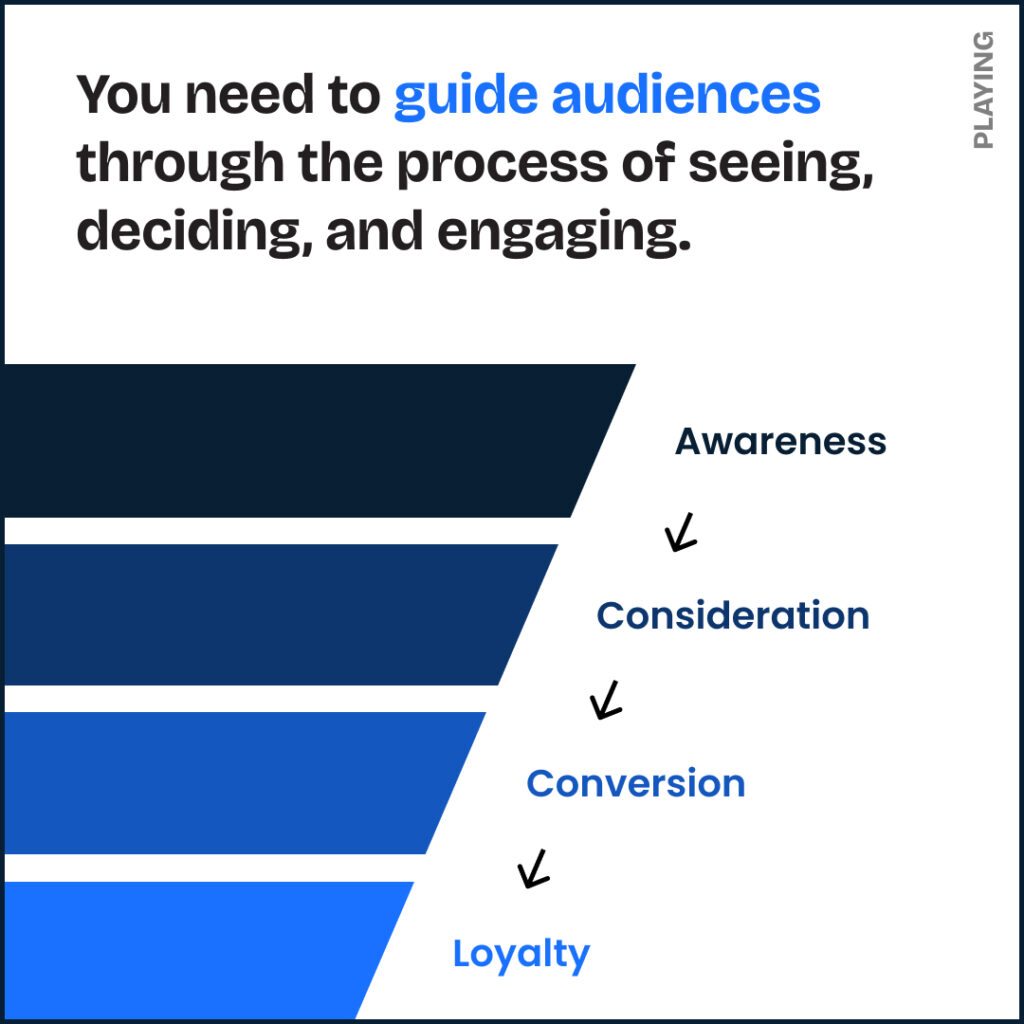
We can’t expect one message or one interaction to do all four of those things. And this journey works much better when we’re not asking people to come find us.
It’s critical to position your organization and campaign in the places that are already interesting and engaging to the people we’re trying to reach. That could be Instagram or email, but it could also be a community event, a local newsletter, a flyer in the neighborhood, a school, a podcast – whatever makes sense for your particular audience.
Before engaging in any marketing activities, here are some principles and questions that can guide you in your strategy development.
Where to begin:
1. Develop a clear action you want your audience to take
Questions to consider:
- What do I need people to do in order to meet my goals?
- What do people need to know in order to take that action?
- What is in their way of taking that action?
2. Get clear on your budget
Questions to consider:
- Do you know what has worked or hasn’t worked in the past?
- Are you trying to maintain or grow performance?
- What are the creative needs (non-working dollars) vs. the performance needs (working dollars) for this effort?
- Have you researched the various estimated costs per advertising platform?
3. Determine which platforms/outlets will be most impactful
Questions to consider:
- Where does my audience spend time?
- What creative resources do I have available?
- Do I have the budget necessary to reach my audience repeatedly?
Crash Course in Paid Media
At a high level, paid media is simply how we amplify your message beyond your existing audience. It allows us to reach the right people, at the right time, with the right message, instead of relying only on organic reach.
There are a few key channels we typically use.
- Paid social and search: This is where we’re running targeted ads across platforms like Meta, TikTok, LinkedIn, and Google. The strength here is precision. We can target based on behaviors, past engagement, or intent signals, and optimize in real time based on performance metrics like CTR, engagement rate, and cost per result.
- TV and Connected TV (CTV): This is all about high-impact storytelling at scale. These are video ads served on platforms like Hulu or YouTube TV. This is especially powerful for building awareness quickly, and we’re typically measuring impressions, video completion rates, and cost per completed view.
- Radio and podcasts: This is an audio-first channel that meets people in their daily routines, like commuting or working out. You’d be surprised at how many people still listen to the radio! It’s great for reinforcing messaging and building familiarity over time, and we often look at reach, frequency, and lift in brand awareness or search behavior.
- Out-of-home (OOH): This includes billboards, transit placements, and digital screens in public spaces. This is about visibility in the real world and creating cultural presence. Success here is often measured through impressions, geographic reach, and downstream lift in search, site traffic, or social engagement.
Together, these channels allow us to build a layered approach. We’re not just showing one ad in one place, we’re creating multiple touchpoints that reinforce each other and move people toward action.
If you’re finding success with your paid media and you want to scale your efforts, here’s what we suggest.
1. Build on what’s working
Considerations:
- Add budget to top performing placements or creative
- Develop more creative
- Increase frequency or expand targeting
2. Expand to new channels
Considerations:
- If you’ve found a CTA or creative that works, test it on additional channels
- Look at where your target audience spends time that you’re not currently reaching
- Start with a small test budget, establish a baseline, then scale
3. Activate retargeting and lookalike audiences
What this means:
- Install the necessary pixels or tracking tags on your site
- Upload your existing customer list to ad platforms to create lookalike audiences
- Segment your retargeting audiences by intent level
Developing Creative that Motivates
Once you understand your audience and the channels to reach them, how you reach them is critical to driving action. In some campaigns, you have access to a team of designers, video editors, and copywriters and other times you have to figure it all out yourself. In either scenario, and for every scenario in between, grounding your work in these tried-and-true methods will allow you to do the best work possible.
1. Lead with the benefit, not the feature
Considerations:
- Focus on what matters to your audience – the feelings, the experience, the opportunity, the connection
- Highlight the impact that their efforts can have on the community or the issue you’re trying to address
2. Keep it simple, really simple
Considerations:
- One message and one action per ad
- If something is too complicated to communicate quickly, consider refining your messaging or using a different marketing tactic
- The media landscape is busy – clarity helps you be memorable
3. Emotion supercharges memory
Considerations:
- When you can tie an emotion to what you’re saying, people are more likely to remember
- Find the emotional connection and communicate it either visually or in the messaging
Collaborating with Influential Voices
Simply put, people trust other people more than they trust brands and organizations, which is why smart influencer collaborations can be so impactful.
There are many ways to describe the influential people that you might want to work with: Influencer, creator, talent, tastemaker, KOL (key opinion leader). Ultimately, all of them are nuanced ways of describing someone who has an audience that listens to and trusts them. The key to doing great work with these influential people is to be truly collaborative and remember that they are the experts at what interests and motivates their audience, and that you are the expert in what’s most important for your mission and campaign.
Once you’ve started to get familiar with a few partnerships, take your next steps by following the principles and key questions below.
1. Start with a small roster, then expand
Considerations:
- Start with a few key partners – then, once you’ve determined what works for your audience and your brand, you can expand from there
- Some of your creator relationships might even recommend other creators you can work with
2. Extend the mileage of high-performing content
Considerations:
- If content is performing well, you can further amplify it through paid efforts
- If a partnership or campaign you’re working on with a creator is newsworthy, you can pitch it to relevant media outlets
3. Build long-term relationships
What this means:
- When you find creators who resonate with your target audience and align with your organization, it’s smart to work with them repeatedly so that you can build a relationship between their audiences and your brand
- Continued partnerships allow for audiences to be part of a larger narrative, which is more memorable and compelling than a one-off
Creating the best experience with your influencers:
- Finding the right influencer:
- Be clear on deliverables: how many posts, what format, what timeline, and how you’ll measure success
- Look for creators whose content naturally aligns with your product — the partnership should feel natural, and not forced
- Check engagement rate, not just follower count. A creator with 20k highly engaged followers often outperforms one with 500k passive ones
- Outreach tips:
- Easy-to-understand overview of who you are and what you do
- Clear goals and priorities
- Lots of room for creative freedom
- Engaging and reporting:
- Make sure your brand account is engaging with the content and with the comments
- Report on the content within 24 hours, 1 week, and 1 month
- And enjoy!
If you actually read every single word and bullet-point in this blog, we commend you! If you skimmed it, we hope you found exactly what you were looking for and commend you as well 😉
We hope you can use this as an ongoing resource for your campaign this year and your future work. For anyone who has questions or would like to share some of the great work you’ve done, feel free to drop us a line at hello@playing.studio. Thank you for making the world a better place through your efforts!