Some beliefs survive not because they’re true, but because they’re convenient. In the age of fake news, the social impact sector is generally more truthful — and trustworthy — than other sectors, but we’re not immune to perpetuating myths, treating anecdotes as facts, or letting our subconscious bias influence our decisions. For example, when we build engagement and fundraising strategies on the preconceived idea that young people don’t give (they just click), or that they don’t give to formal charitable organizations (they give to friends), to whose benefit is it? And are either stories true?
The good news is that we no longer have to guess. The GivingTuesday Data Commons has just released country snapshots as part of the State of Generosity report, including Brazil and Mexico, countries that together account for over half the region’s population. The insights come thick and fast, with numbers on who gives, how and to whom, as well as emerging research on civic intent (willingness to contribute) and civic values (beliefs about individual agency and trust in institutions). Crucially for social sector leaders planning for younger generations, the data is broken down by age, so we can look past the stereotypes and understand how under-35s are really giving in each country.
Mexico: generosity grows, with young people in the mix
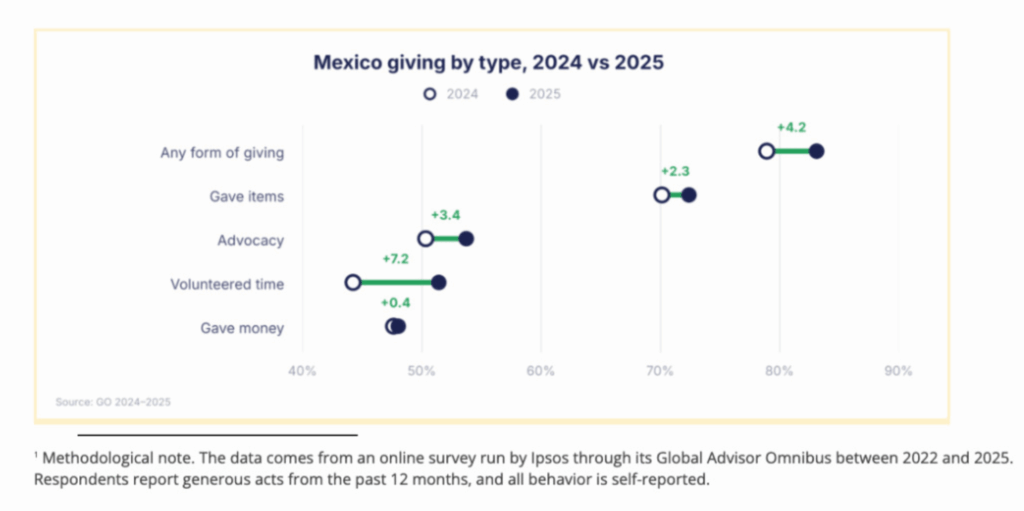
The panorama in Mexico is optimistic: participation in all modes of giving (monetary, items, volunteering and advocacy) rose to 83% of respondents, up from 79% in 2024. The number of individuals reporting they gave items showed steady growth, and volunteering recorded the largest increase in participation. As for where people gave, 73% of people supported other individuals directly, while 69% supported formal charitable organizations, and 66% informal community groups.
Yet it’s how people give that is most interesting. Older adults rely more on direct personal giving: 63% of those aged 50 to 74 gave directly to a person in need, compared with 40% of under-35s. Younger adults, unsurprisingly, are more likely to give online. The surprise is where that online giving goes: to formal charitable organizations, and at higher rates than among older adults. Under-35s give through charity websites (20%) and intermediary platforms like GlobalGiving (19%), against 9% and 14% of those aged 50 to 74s. That doesn’t mean young people give more than older people overall, but it does show where they give. The young people so often assumed to be clicking past causes are, in fact, giving to them.
Brazil: generosity dips, but young people show up in person
If Mexico breaks the first myth, Brazil breaks the second. Brazil’s under-35s are not retreating to their screens. Online giving to charity websites fell in 2025 across all three age groups, and young Brazilians are giving more in person. Under-35s showed a rise in in-person giving, from 16% in 2024 to 28% in 2025.
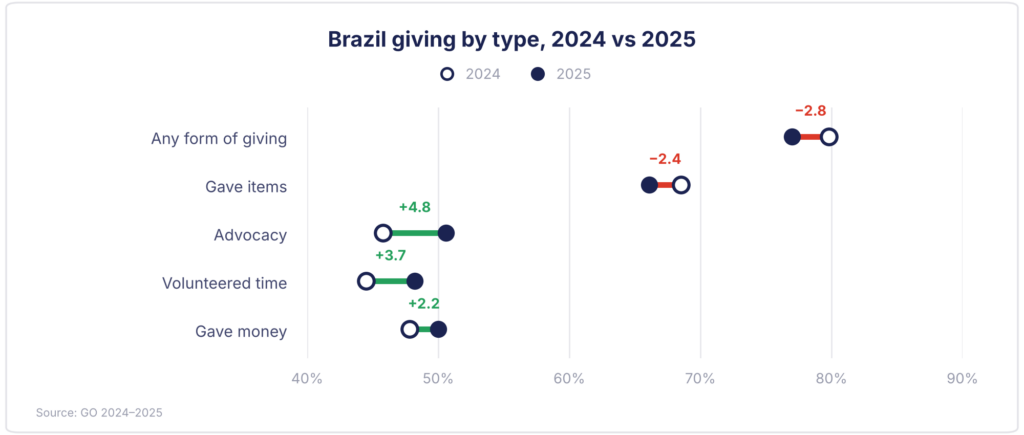
That’s happening against a backdrop of slight decline in giving overall: the share of Brazilians who recorded at least one act of generosity slipped from 80% to 77%, and giving to formal nonprofits fell from 70% to 62%, although giving to informal groups rose slightly.
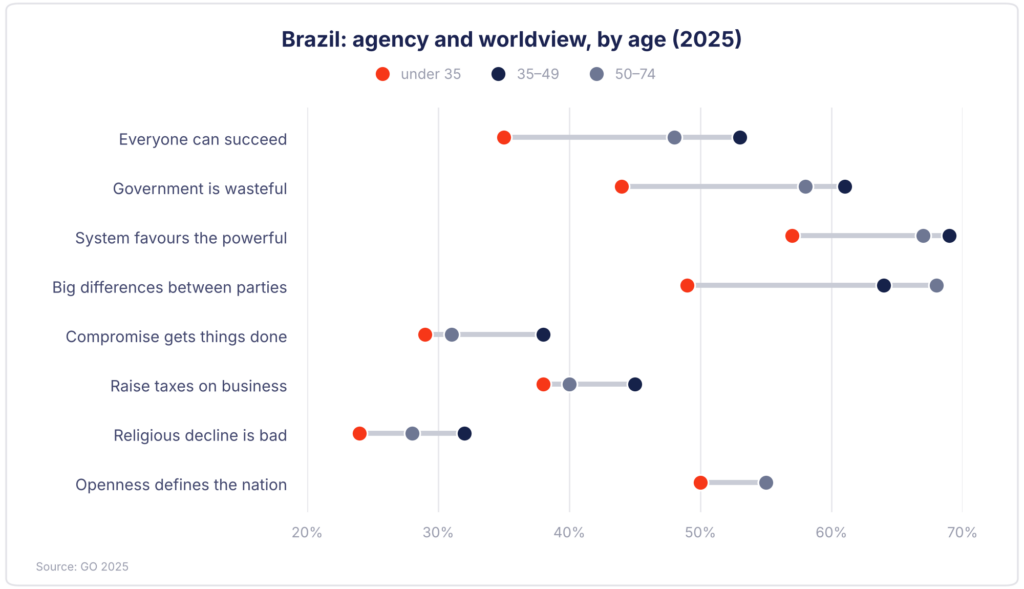
We can’t say why. Yet one number that stands out in relation to the survey section on civic values is that only 35% of Brazilians under 35 agree that everyone has the power to succeed, the lowest of the countries surveyed, and well below the US (50%), Great Britain (55%) and Kenya (86%). It’s only a hypothesis, but it may be that a generation that is less confident in institutions or individual effort may put its trust in relationships with people around them.
Unlearning what we think we know
Young people are giving actively across Latin America, just not always in the ways we expect. There is no single story, and assumptions can be costly. Whether you work in Mexico, Brazil, or somewhere else, here are three ideas to boost generous giving:
- Let go of the scarcity mindset. Don’t assume young people won’t give, and instead give them multiple ways to do so. Make room for them in your activations and campaigns from the start.
- Make online giving easy. Reach out to people on digital messaging platforms and give them a simple, fast way to donate using the payment methods they prefer.
- Don’t hand everything to digital. Invite young supporters to events, volunteering and conversations in person and keep building those relationships on and offline.
And if you support nonprofits, as a funder, fundraising platform or capacity builder, you are in a unique position to close the data gap. Help organizations track their supporters by age and giving channel, and share what you learn so the whole sector benefits.
If this has piqued your curiosity about young people’s giving, there’s much more in the data. Explore the country reports to dig into their attitudes and behaviours, or zoom out to see the picture across each country.