Making generosity visible is one of the most reliable ways for it to grow. When people see their neighbors giving, they tend to give more themselves. But what about people for whom this doesn’t quite work that way? We explored their behavior more for clues as to why.
In our earlier work, The Perception Effect, we sorted people along two lines: how strongly they personally hold giving as a value, and how generous they believe others in their community to be. Those two questions define four groups (see Figure 1): givers who are surrounded by other givers (Givers in Community); givers who give unconditionally regardless of peers or visibility (Isolated Givers); insularists surrounded by others who don’t give (Insularists); and a group we call the Spectators. The Spectators were the hardest to understand.
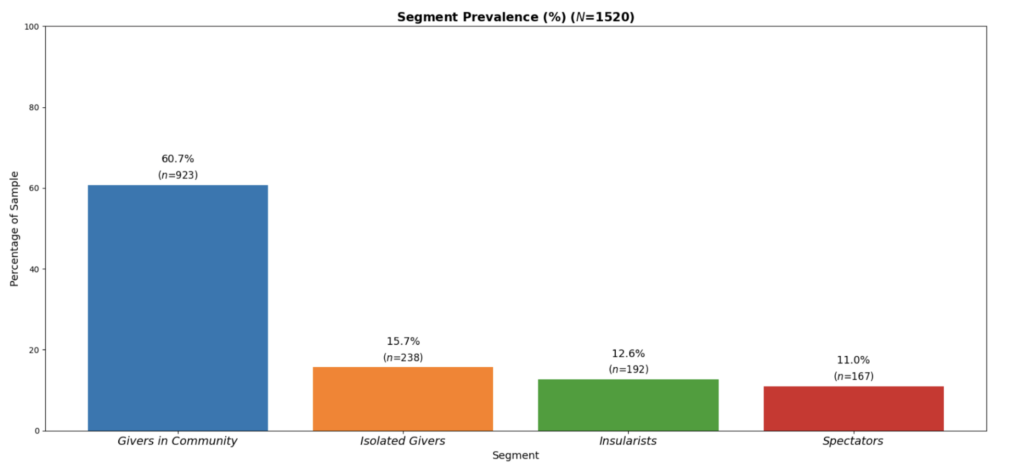
Figure 1
Who the Spectators are
Spectators are people who don’t personally prioritize giving and helping others as a core value, but who feel they are surrounded by others who do. They’re the smallest of the four groups — about 11% of the people we surveyed in our GivingPulse survey — compared with the 61% who both hold strong giving values and feel surrounded by like-minded people.
On paper, Spectators should be the easiest group to sway. They’re surrounded by generosity, they see the norms, and they’re positioned to be pulled along by the people around them. So we expected a simple result: the more giving they’re exposed to, the more they’d give.
That’s not quite what we found.
Spectators give more when others do, but don’t give in more ways
Consider two aspects of generosity (see Figure 2):
1. Does a person give at all?
2. If they give, how many different ways do they give?
On whether people give at all, Spectators behave like everyone else. Across every group, the more giving-related information and requests people were exposed to, the less likely they were to give nothing — about 38% less likely, on average. Spectators fit that pattern right alongside the others. Being surrounded by giving does seem to help get them in the door.
On how broadly people give, Spectators stand apart. For the other three groups, more exposure went hand in hand with a wider range of giving — roughly 22–25% more ways of giving. For Spectators, that same exposure barely moved the needle — about 4%. This was the one difference large enough between groups that we’re confident is real and not just noise.
It isn’t that social visibility does nothing for Spectators. It seems to help them start. It just doesn’t seem to broaden how they give the way it does for everyone else.
Measuring one’s sociality and breadth of generosity
First we counted up how much generosity flowed through their social circles, broadly speaking. Our survey asked whether they’d heard about recent disasters or charities in the news; if they’d been asked to give; taken part in a workplace drive; seen giving reminders; talked with others about a decision to give; knew about GivingTuesday; and so on. The more of these signals that surrounded someone, the higher their social score.
Second, we measured how broadly a person gave. We counted four modes of giving: money, time, advocacy, and item donation. We then measured it across two different social dimensions: supporting an organization or giving directly to a person. The eight possible combinations define how broadly a person gave.
Why this might happen
We can’t prove the cause from this data, but two well-established ideas offer plausible explanations.
The first is about identity. People respond most to cues that match how they already see themselves.¹ If giving is central to who you are, watching your community’s generosity reinforces that — it feels like an expression of you. For Spectators, for whom giving is less central, the same cues may simply carry less personal weight. That would explain the split we see: the signals reach them and get them to act, but don’t resonate deeply enough to expand the habit.
The second is about where motivation comes from. Giving that is driven by outside pressure (a reminder, a request, an expectation) tends to be more fragile than giving that’s become personally meaningful.² Spectators can be nudged into an act of giving, but without a reason of their own, that nudge doesn’t compound into a broader pattern the way it does for people whose giving already sits inside their own values.
What this might mean in practice
For 76% of respondents, more visible giving tends to promote more and broader giving. Strategies that increase visibility are likely to work well.
For Spectators (11%), the order may need to flip. A personal connection to a cause might have to come first, before social signals matter. Easy low-lift opportunities to help are probably more effective than messages such as, “See! Everyone is doing it.”
For organizations, it’s less of a tradeoff when you realize that nearly everyone (89%) would be more involved if asked more, and yet only about 7 out of 10 people get involved each week. There’s still room to grow.
Unresolved questions
- How much is this identity-driven? If giving isn’t central to how someone sees themselves, how much can that actually shift? And what works? A small positive experience? Hearing a peer’s story?
- Do Spectators need their own reason to care before social exposure matters? Or is the relationship more complex than that?
Conclusion
Generosity isn’t one story. People show up in their community through different paths. Values, identity, and personal life goals are interwoven around external social influences. For one subset of people, what people around them are doing just doesn’t matter to them. The way to engage them likely involves understanding their internal beliefs and attitudes more.
─────────────────────────────────────────────────
¹ Identity-Congruence theory (Stryker & Burke, 2000; Aquino & Reed, 2002)
² Self-Determination Theory (Deci & Ryan, 2000)
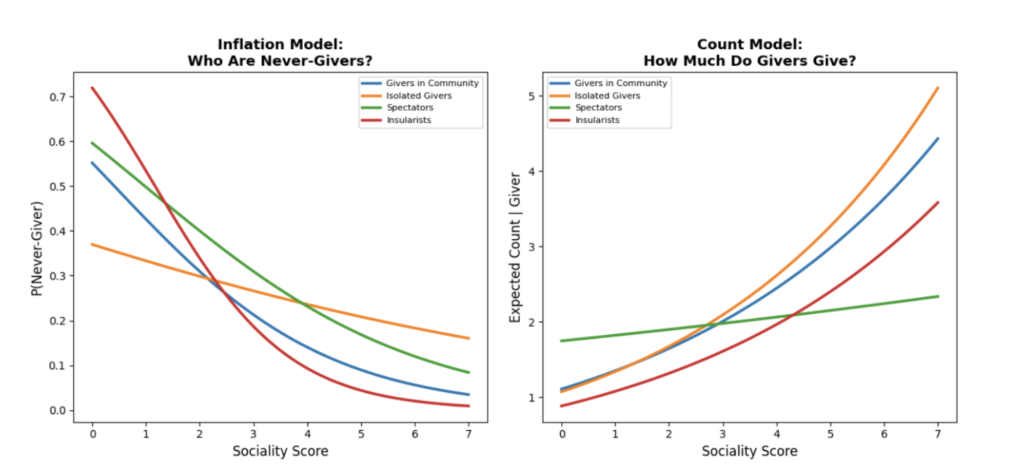
Figure 2