

Recurring giving is one of the most reliable sources of nonprofit revenue. When donors authorize automatic, repeated contributions on a set schedule, it provides organizations with stability and the opportunity to build long-term relationships with donors, instead of constantly chasing one-off gifts.
Monthly giving is by far the most common form, making up roughly two-thirds of all recurring schedules.
And yet the sector is leaving significant opportunity on the table, upwards of $20 billion a year, according to our data.
To mark the launch of Monthly Giving Awareness Week on Monday, May 11, the GivingTuesday Data Commons is releasing new research drawing on five years of transaction data from the Fundraising Effectiveness Project (FEP), covering hundreds of millions of gifts across tens of thousands of organizations from 2021 to 2025. It’s our most comprehensive look yet at the structure and value of recurring giving across the U.S. nonprofit sector. Here’s what we found.
What we know about recurring giving, and where there is room to grow
Recurring giving is growing, but slowly. Around 90% of organizations had at least some recurring activity in each year we analyzed. But in 2025, the median organization had only about 4% of donors on recurring schedules, suggesting that a relatively small number of organizations drive much of the sector’s recurring activity.
The share of donors on recurring schedules rose from 6.6% in 2021 to 7.9% in 2025. However, most of that growth is possible because of retention – organizations holding onto the recurring donors they already have, not from bringing new ones in.
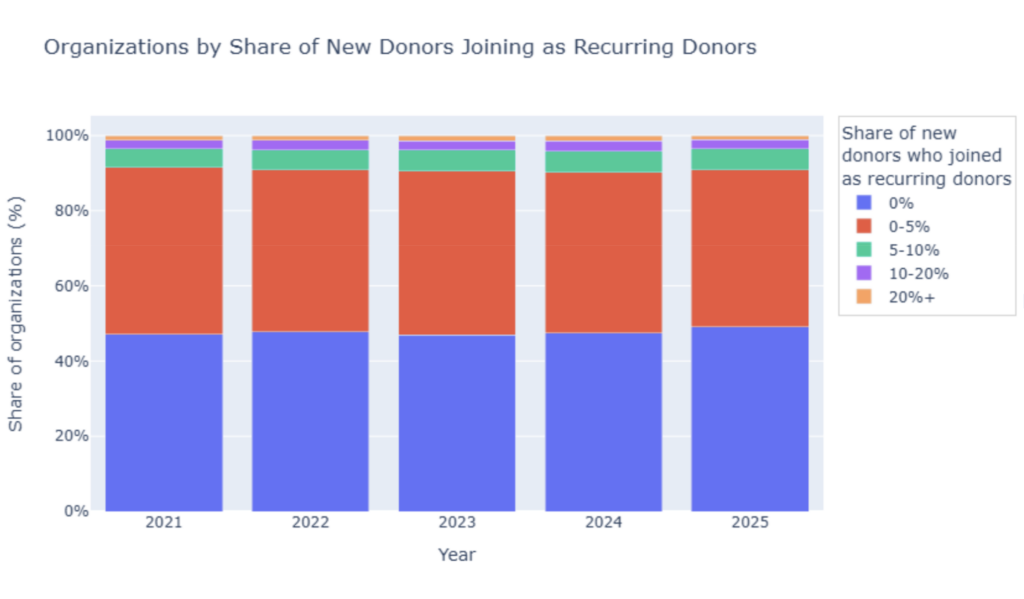
In every year of our dataset, the median organization acquired effectively zero new recurring donors. At least half of all organizations in the panel acquired no new recurring donors at all in any given year.
The composition of the recurring donor base each year has shifted. In 2021, a much larger share of recurring donors were new to recurring giving. By 2025, the base of recurring donors was increasingly made up of donors who have been giving on a recurring schedule for two, three, or four or more years. The pool is growing, but it’s being carried by donors who converted years ago, not a steady flow of new recurring donors.
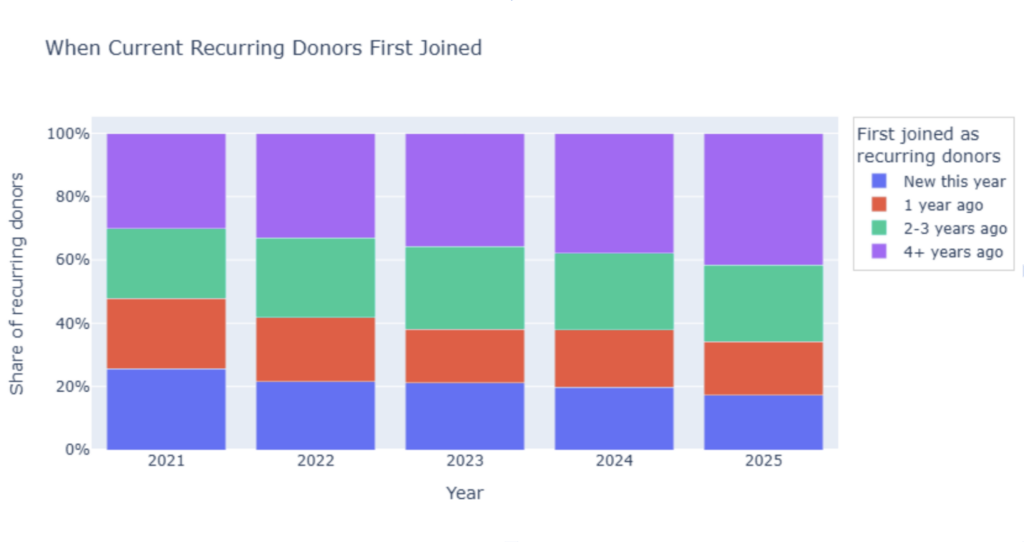 This means the sector has real work to do. The recurring base can’t grow on retention alone, so organizations need to get better at bringing new donors into recurring programs.
What we can learn from different recurring giving schedules
Recurring donors on different schedules behave differently, and that difference has some practical implications.
Monthly schedules — one of eight cadences tracked in this research, alongside weekly, biweekly, quarterly, annual, and others — make up roughly two-thirds of all recurring schedules, and their share of total recurring revenue grew from 73% in 2021 to 84% in 2025. Every other schedule type declined in relative importance over that period, though annual and quarterly schedules still contribute a meaningful share of dollars, despite being less common. Donors on monthly schedules have a median annual value of $275, compared to $100 for non-recurring donors.
One pattern that stood out: monthly donors tend to set their schedule and let it run. Only about 30% made any supplemental one-off gift in a given year, which makes sense, given they’re already giving every month.
But when they do give more, those gifts tend to be significant: a median of $77, larger than supplemental gifts from donors on any other schedule, and two to three times the size of their own recurring gift. Donors on less frequent schedules — like quarterly, semi-annual, and bimonthly — give extra gifts at much higher rates, around 85%, but those gifts tend to be smaller.
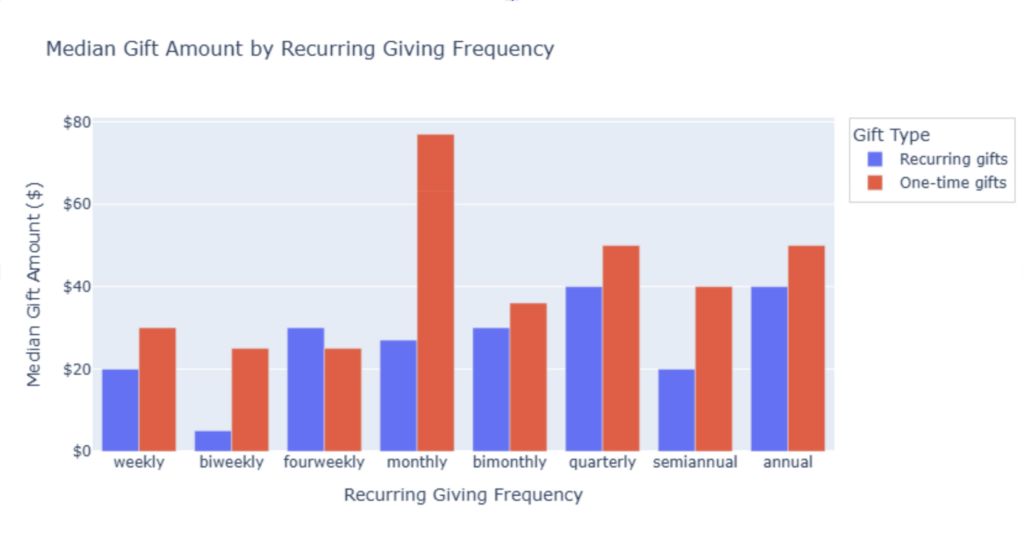
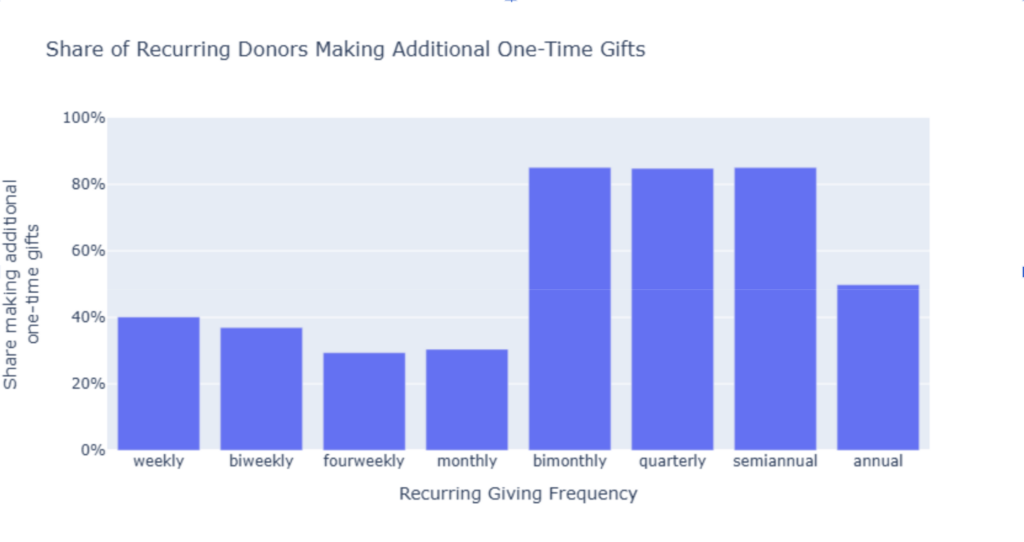
Our relationships with recurring donors may be more nuanced than they might first appear. Monthly recurring donors in particular may present an opportunity for engagement outside their scheduled giving, and for how organizations connect with them beyond the recurring transaction itself.
What this means for your organization
The data point to a clear tension: recurring giving is one of the highest-value elements a nonprofit can build, but most organizations aren’t actively growing it. The donors who are already giving on a recurring schedule are largely sticking around.
How do we deepen those relationships and bring more new donors into that pipeline?
Monthly Giving Awareness Week, running Monday, May 11–Friday, May 15, is designed to help nonprofits learn to do both. Whether you’re just starting to build a recurring program or looking to deepen engagement with the donors you already have, the week offers free resources, practical tools, and a community of practitioners working on the same challenges.
Read more about the recurring detection methodology here.