The Alignment Question
At GivingTuesday, we don’t just track what Americans do to help their communities, but also their beliefs about helping – and, more recently, what they think their neighbors believe. We have been asking these questions:
- Does alignment between personal values and perceived community norms influence outward generosity?
- Can people who are not inclined toward civic engagement be influenced by seeing more generous action in their community?
Using data from our ongoing weekly national GivingPulse survey, we examined how a person’s prosocial attitudes – the desire to help others across differences, and contribute to community wellbeing – interact with their perception of whether those values are shared with others in their community.
We asked people how much they agreed or disagreed with these statements:
- I am helping to make my community a better, more civil place
- I strive to help those most in need, even if that means helping those from my community less
- I help others, even people whose beliefs, politics, or lifestyle I don’t agree with
We then used their level of agreement to place respondents on a spectrum, ranging from wanting to help others without any reservation, down to being uninvolved with one’s community and not aspiring to help. Based on this, we found that 44 percent of people agreed with all three statements (altruists), compared with just 6 percent who disagreed with all three (those furthest from being altruists).
We also asked people to respond to these same statements, but reframed around their perception of others in their community, “I believe others in my community are…”¹ We assigned respondents to one of four groups, depending on whether they were above or below the median agreement² with these statements about themselves and others, so we could see how self-identity and community perceptions relate.
These attitudes are part of how we measure a holistic quality we call Civic Intent³: the desire to contribute to the common good, engage across divides, and participate in public life. Differences in average Civic Intent scores across these groups reflect differences in civic engagement, based on real and recent generosity. By comparing Civic Intent, we can see whether a person’s perception of others’ attitudes influences their general proclivity toward helping others.
How does community perception change one’s own generosity?
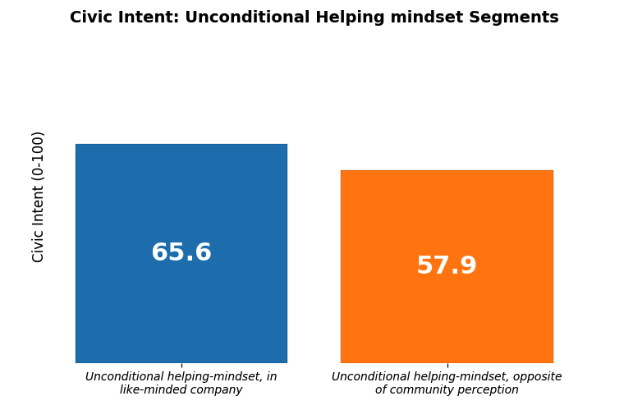
Unconditional helping mindset, in like-minded company – people who value helping others and perceive their community as sharing these values – score highest on Civic Intent at 65.6, more than six points above the population average (59) across the last five quarters. These people personally value helping across differences, and believe their community does as well. They are operating with full alignment between their values and what they perceive around them.
Unconditional helping mindset, opposite of community perception – people who value helping others but don’t believe their values are mirrored in their community – score 57.9 – scored over seven points lower. This difference is 11x larger than the fluctuations we have seen in these scores over time. The gap may reflect how a lack of inspiration from others leads to less engagement in one’s community.
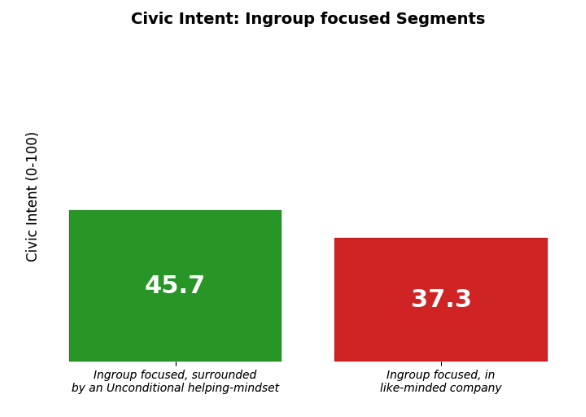
Ingroup focused, surrounded by an unconditional helping mindset – people who do not personally prioritize helping across differences, but perceive others in their community as engaged – score 45.7. This is more than eight points higher than the score for people who perceive a like-minded community, but don’t agree that helping others is important, and it is closer to the typical average in the whole population (59).
The perception of being surrounded by other do-gooders alone is perhaps enough to result in taking some action, at least a little more than those who perceive they are surrounded by like-minded people who are less inclined to help. We ask only about perception, but there are probably real relationships involved: nudging, inspiring, encouraging friends and family into action. This aligns with what other researchers have found: that altruism spreads through social networks⁴, making perceived community norms a potential accelerant for that spread.
Ingroup focused, in like-minded company score 37.3. They are less likely to value “striving to make their community a better place,” or “helping those most in need over those in their own community,” and are surrounded by like-minded people, and so they appear to do these things less often.
All of these differences in Civic Intent are statistically significant with meaningful effect sizes. Perceived community alignment has a moderately strong effect on do-gooders and those less inclined to help.⁵
What the numbers actually tell us
These differences suggest that perceiving one’s community as engaged in helping appears to influence people’s individual intentions and actions. People who felt their community is mostly do-gooders scored five points higher on Civic Intent⁶. Those who aspired to do good but who felt isolated in a community of less-aspiring folks, scored five points lower. People who are less personally driven to help others may, to some extent, be influenced by knowing that there are others in the community who are.
How much do intentions translate into behaviors, such as giving money or volunteering time? Being surrounded by other do-gooders increased the percentage of doing these things by nine percent:
- 74.4% of unconditional helpers in like-minded company reported recent generosity, compared to 65.8% of isolated helpers.
- 58.5% of ingroup focused surrounded by an unconditional-helping mindset engaged, compared to 49.5% of ingroup focused, in like-minded company.
The Perception Question: Caveats
We asked people about their beliefs regarding community engagement, not objective measures of what their neighbors actually do. This is something we will examine in the future. Perhaps, as part of community- building, fixing perceptions and dispelling illusions about others is more effective than raising awareness about the activities themselves.
Conclusion
It is inspiring to realize that most people want to help. Amongst respondents, 45% agree with helping others in unconditional ways, while only about 6% disagree with all three statements. The remaining 49% are open to influence and already doing some good.
Based on responses collected between late June and early October 2025, our data reveal that civic engagement is shaped both by what we personally value and what we believe our neighbors value. This alignment shows up not just in attitudes, but also in actual rates of giving and volunteering. Making generosity visible may be an important factor in fostering more of it.
Wondering how you can turn this data into strategy?
Our colleagues at RKD Group offer suggestions for how to translate this data into strategies for fundraising and marketing teams. Check out their blog Perception matters: What nonprofits can do with GivingTuesday’s new insights on community generosity.
──────────────────────────────
¹Our exact community perception questions were: “Most people I know believe they can make a difference in their community”; “I believe others in my community are willing to help people whose beliefs, politics or lifestyle they don’t agree with”; “I believe others in my community are willing to help those in need, even if it means helping those outside the community less.”
²While this analysis is based on being above or below the median level of agreement with three questions on our 4-point likert scale, we also used more stringent criteria (agreement/disagreement with ALL of the questions) and reached the same conclusions, but with smaller sample sizes and larger differences.
³Details for how we calculated and vetted Civic Intent as a composite, unbiased indicator for civic engagement, read our 2024 report.
⁴ TED https://www.youtube.com/watch?v=2U-tOghblfE by Nicholas Christakis
⁵Statistical analysis reveals Cohen’s d = 0.54 for the difference between Unconditional helping mindset in like-minded company and Unconditional helping-mindset, opposite of community perception (t = 7.24, p < 0.001), indicating a medium effect size. For the Ingroup focused, surrounded by an unconditional helping-mindset versus Ingroup focused, in like-minded company, Cohen’s d = 0.46 (t = 4.41, p < 0.001), representing a medium effect. In practical terms, perceived community alignment matters substantially for those who already value altruism, while perceiving community altruism provides a gentler but still meaningful nudge for reluctant participants.
⁶Alignment between personal altruistic attitudes and perceived community altruism explains 31.32% of the variance in Civic Intent scores across our sample (n = 1488). While this represents a meaningful relationship, it also indicates that about 69% of the variance derives from other factors. These alignments shape civic engagement but are not deterministic.